
EXPLORE PAUL WINTER'S WORLD OF LIVING MUSIC:


Reviews
More World Music
About Oscar Castro-Neves
About Paul Winter
Living Music by Style
All Titles
Free Draw
Special offers
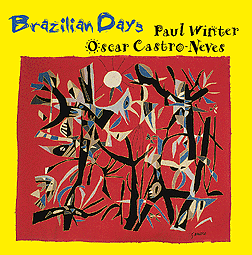
BRAZILIAN DAYS
Paul Winter and Oscar Castro-Neves
(LMUS 0034)
ARTISTS | TRACKING
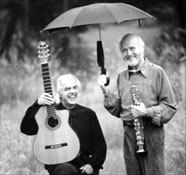
It is a testament to the universality of Bossa Nova that BRAZILIAN DAYS, the Living Music set from saxophonist Paul Winter and guitarist Oscar Castro-Neves, began life in the loft of Winter's rural Connecticut barn. It was there in the bright New England spring that the two old friends and master musicians poured through a virtual treasure trove of Bossa Nova classics, and began to shape the contours of what would become their premiere duet album. The results are nothing less than a stunning rebirth of one of the most influential popular music styles of the last fifty years.
|
"It was a lot of fun for me," recalls Castro-Neves of the experience. "It was a way of looking back, of revisiting my past." As one of the true pioneers of the Bossa Nova movement, Oscar speaks the truth. He was there in Rio de Janeiro in the late 50's when geniuses like Antonio Carlos Jobim and Joao Gilberto first blended the impressionistic harmonies of Ravel and Debussy with syncopated rhythms of Brazilian music. Bossa Nova (Portuguese for "new touch") was born then, and it changed the world of music forever.
Winter and Castro-Neves took their time paring down 150 songs to a manageable number. In March of 1997, Paul and Oscar recorded demos of 50 favorites, and from there the final dozen were chosen. In September, the pair were joined in the studio by bassist Nilson Matta and drummer Paulo Braga, two seasoned veterans of the Brazilian music scene both in the USA and in Brazil. "It was a natural match," says Oscar. "Both musically and personally, it was an atmosphere of sharing." Adds Paul, "We wanted to be totally simple and totally gentle in the original Bossa Nova tradition."
Paul then packed up the master tapes and took one of his heralded recording expeditions to the Grand Canyon. He had previously recorded two albums, CANYON and CANYON LULLABY, in the pristine outdoor environment of the Canyon. "I had found a wonderful side canyon there in 1985 with amazing acoustics," says Winter. "We called it Bach's Canyon. Because I love how it feels to play there, I wanted to do my sax parts for BRAZILIAN DAYS there too. We back-packed into the Canyon a pair of DA-88 8-track machines, solar power gear, a mixing board, food and tents for a ten-day stay. It was amazing to be this far from civilization and to put on earphones and hear this exquisite Brazilian music. I closed my eyes and was in heaven."
Most of the songs on BRAZILIAN DAYS would likely be unfamiliar to North American audiences, who may readily recall classics like "Girl From Ipanema" and the theme from "Orpheus," but don't know the bulk of Bossa Nova standards. "We made no concession to commercialism," says Paul. "We didn't do the hits. We wanted to make an album with something of the same ingenuous attitude that Jobim and Gilberto had when they recorded their first albums in the 50's."
Some of Bossa Nova's greatest composers are represented on the new album; Jobim, Carlos Lyra, Noel Rosa, Vinicius de Moraes, Edu Lobo and Luiz Eca among them. Songs include "Aula de Matemática," "Coisa Mais Linda," "Feito de Oração," "Feio Nao E Bonito," "Minha Namorada," "Tambén Quem Mandou," "Ana Luiza," "Feitiço da Vila," "Canto Triste," "Imagem," "Por Causa de Você," and "Se é Tarde me Perdoa." All are performed with characteristic grace and serenity, with understated eroticism and playfulness.
|
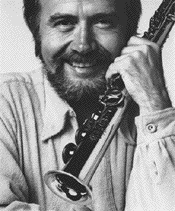
Though the only non-Brazilian in the quartet, Winter had long ago earned
the admiration of his Brazilian colleagues. "Paul has been living this
music for a long while," says Oscar. "When you listen to the album,
and hear his phrasing, his spirit, you see how well he understands the music."
Paul Winter was one
of the first American jazz musicians to go to Brazil and encounter Bossa
Nova first hand. As a student at Northwestern University (Chicago), he had
formed the Paul Winter Sextet in 1961. Quickly signed by Columbia Records,
in 1962 the group became the first student jazz group ever sent abroad in
a U.S. State Department-sponsored tour. Destination: South America. In June
of 1962, following the Sextet's concert in Rio de Janeiro, Paul met a young
Brazilian guitarist named Oscar Castro-Neves. The music of Brazil so enthralled
Winter that he returned in 1964 for a longer visit, spending most of a year
living in the Ipanema section of Rio and recording with Brazilian musicians.
|
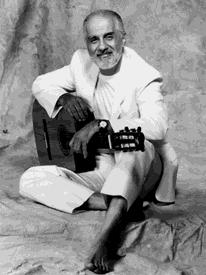
A jazz aficionado since his early teens, Oscar too was swept up in the creative
energy typified by the advent of Jobim and Gilberto. He went on to become
one of his nation's leading jazz guitarists/composers/arrangers. A move
to the United States in the late 60's helped him broaden his audience. His
old friend Paul Winter enlisted him to join the increasingly popular Paul
Winter Consort, which earned legions of fans of all generations
thanks to albums like ROAD and ICARUS
(which was produced by the Beatles' George Martin, who described it as "the
finest album I've ever made").

In 1980 Winter founded Living Music, his
own label and home base, which blended Paul's love of music and his passion
for the natural environments of the earth. The label went on to release
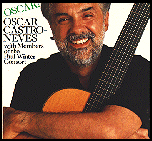
albums by Winter, Castro-Neves (OSCAR! in
1986), Pete Seeger, and even some that included non-human voices such as
SONGS OF THE HUMPBACK WHALE and DEEP
VOICES. For more than twenty years, the Grammy-winning musician,
composer and producer has been a tireless crusader to bring music, as well
as spiritual and environmental awareness, to a vast audience, having played
in more than 30 countries during his career.
|
Oscar has enjoyed an equally successful career. He recently teamed with
Yo Yo Ma on the cellist's chart-topping Tango album, and he served as producer/arranger
for Otmar Leibert's best-selling album. He tours frequently, and, for the
last six summers, has been the mastermind behind the annual Brazilian music
night at the Hollywood Bowl. Oscar also co-produced the recent Toots Thielemans releases THE BRAZIL
PROJECT and CHEZ TOOTS.
Even with their many diverse projects, both Paul and Oscar agree the time
has come for a resurgence of Bossa Nova. "It's coming back, the same
way the music of Parker, Gillespie, and Coltrane is coming back," notes
Castro-Neves. "For many people, these are the roots of their musical
world. Young people are looking for the sources." Adds Paul, "In
the 60's, Bossa Nova was over-commercialized, and the simple magic we knew
in the beginning was lost. Other kinds of popular music took over. The world
was going too fast, and that quiet moment was trampled over. But this music
is as timely and vital now as it was then. It has stood the test of time."



